
Nóra HEGYI-HALMOS & Orsolya Anna PONGOR-JUHÁSZ & Tünde TÓTH-TÉGLÁS
Technological progress leads to the disappearance of certain professions, the creation of new job roles, and the significant transformation of existing positions. The rise of automation and generative artificial intelligence continuously reshapes the world of work, generating entirely new job structures that demand new types of competencies from employees (Frey & Osborne, 2017; McKinsey, 2022). Repetitive tasks are increasingly performed by machines, leading to the gradual disappearance of routine jobs while elevating the importance of roles that require human skills, creativity, and strategic thinking. Data-driven decision-making and the management of automated systems have become fundamental requirements across most industries, making digital literacy and technological adaptability essential competencies. Emerging technologies not only transform communication methods but also redefine collaboration and work organization (Manyika & Sneader, 2018).
The globalization of the labor market and the rise of the gig economy have introduced new challenges to the economy. The increasing prevalence of flexible, digital work necessitates different skills from employees, including independent time management, virtual teamwork, and intercultural communication. The COVID-19 pandemic (2020 – 21) accelerated these changes, leading to the widespread adoption of remote, hybrid, and online work arrangements (World Economic Forum, 2020). The expansion of the gig economy has also compelled workers to adopt an entrepreneurial mindset, as more people engage in contract-based or project-based employment rather than traditional full-time jobs.
Demographic changes, increasing diversity, and efforts to promote inclusion also shape the labor market (OECD, 2021). Aging societies necessitate lifelong learning and continuous upskilling of employees. Companies are increasingly recognizing the benefits of a diverse workforce and placing greater emphasis on equal opportunities and inclusive corporate cultures. These factors underscore the increasing importance of soft skills, including empathy, teamwork, and cultural awareness. Over the past decade, lifelong learning and retraining programs have gained increasing importance, becoming essential due to the rapidly evolving competency requirements (Lukács & Dorner, 2021).
Along with technological, economic, and social changes, the skills and competencies required for high-level professional practice are evolving, raising employers' expectations regarding workforce qualifications (Tóth et al., 2015). Employers are placing greater emphasis on both transferable and specific competencies. Transferable skills – such as communication, critical thinking, problem-solving, and adaptability – have become particularly valuable as they enable workers to adjust swiftly to an ever-changing environment (Cimatti, 2016; Bridgstock, 2009). At the same time, demand for industry-specific skills is also increasing, such as proficiency in programming languages, financial analysis, or project management (Autor et al., 2023). Knowledge economies thrive on employees continuously developing and updating their skills (upskilling). Knowledge workers, in particular, play a crucial role by contributing their creativity and problem-solving abilities to the advancement of economies driven by cutting-edge technology (Haragi, 2010). Acquiring a broad skill set, often requiring expertise in new disciplines, builds upon a high level of general education and continuous learning, enabling workers to perform various roles. In more flexible employment relationships (Szabó & Hámori, 2006), the focus is on task completion, and employers increasingly expect employees to adopt a responsible and self-sufficient approach to their work (Kiss-Répátzky, 2012). Consequently, future expectations anticipate a growth in the demand for transferable competencies that are applicable in various work situations and capable of evolving with experience.
Workforce (2016) described these evolving competency expectations as a "skills revolution". The report highlighted the enduring importance of skills such as creativity, emotional intelligence, and cognitive flexibility, which are essential for solving complex tasks or complementing machine functions. Over the past decade, employers have increasingly sought workers with transferable expertise alongside specialized knowledge, valuing those who can adapt flexibly to rapidly changing circumstances (Zerényi, 2017). Randstad's 2025 report states, "In times of unprecedented change, as traditional job roles transform and new ones emerge, skills can quickly become obsolete. Our study indicates that ensuring future-ready skills is more critical than ever for both employers and employees. This necessity is not only driven by the expected economic transformation due to artificial intelligence but also by the imminent emergence of the next disruptive technology, poised to push boundaries even further" (Randstad, 2025, p. 30).
This study aims to explore labor market competency requirements over the past decade by analyzing literature and large-scale research findings. Our objective is to examine the restructuring of competencies essential for successful employment, identifying which skills are losing relevance, which remain critical, and what new knowledge, abilities, or personal attributes will become defining factors in the evolving labor market.
Technological, economic, and social changes significantly reshape the value and content of competencies required in the labor market. This restructuring may involve different directional changes in qualification and skill expectations. The increasing requirements for workforce qualifications are referred to as "upskilling," while the expansion of required skill sets and the broadening of qualification content are termed "multiskilling" (Czibik et al., 2013). The 2018 Cedefop forecast projected a significant increase in the proportion of highly skilled job positions, expected to rise from 31% in 2016 to 40% by 2030. Concurrently, in some areas, a decline in expectations has been observed; the phenomenon of "deskilling" emerges in connection with automation and the spread of computer-controlled technologies. According to the 2018 Cedefop forecast, the share of low-skilled jobs is expected to decrease from 21% in 2016 to 15% by 2030 (Cedefop, 2018).
More recent forecasts from Cedefop in 2023 reaffirm these trends and emphasize the importance of skill development in adapting to changes in the labor market. According to the projections, European employment is expected to grow by 3.4% between 2021 and 2035, equating to approximately 7 million new jobs. This growth is primarily attributed to the green transition, the expansion of the service sector, and the increasing demand in the social care and healthcare sectors due to aging populations. The forecast for 2035 anticipates the dominance of skill-intensive employment in the labor market. The demand for highly skilled workers is expected to increase. In contrast, demand for medium-skilled workers is projected to remain relatively stable, and the number of low-skilled job positions is anticipated to decline (Figure 1). The new job opportunities created by 2035 are also expected to be more accessible to highly skilled individuals (Cedefop, 2023).
Source: (Cedefop, 2023)
The determination of which competencies lose value, which remain crucial, and what new knowledge, skills, or personal attributes will become dominant in the ongoing labor market transformation is ultimately shaped by the interactions of key stakeholders. From a market perspective, workplace competency expectations emerge and evolve through the dynamic relationship between employers and employees, influenced by broader market changes (Tóthné & Hlédik, 2019). Consequently, expectations within organizations are not static variables but continuously adapt to the interplay between supply and demand. A more profound understanding of this process and the evolution of requirements is valuable for all stakeholders, including employers, employees, and the educational institutions preparing the workforce.
Demand-side changes in the labor market primarily drive the restructuring of competencies. In modern developed societies, it is economically advantageous for employers to hire only adequately skilled workers. As technological advancements progress, the demand for low-skilled labor is expected to decrease. At the same time, the need for highly qualified workers continues to grow – even though acquiring such talent becomes increasingly costly and often requires attracting workers from competitors (Kopátsy, 2011). The impact of technological, economic, and social changes is prompting significant transformations within companies, leading employers to rethink and extensively modify their organizational operations, human resource management, and employee expectations. However, employers may differ in their evaluation of the role of specific competencies, both currently and in the future. Some companies proactively build personal and organizational conditions aligned with expected macroeconomic shifts, while others respond more slowly, relying on previously established success criteria essential for maintaining their current performance. As a result, the timeline for changes in employee expectations can vary significantly across organizations.
Naturally, the skills and knowledge considered valuable differ across industries, as corporate strategies dictate diverse competency needs. The emergence of skill shortages is not solely driven by new demands from companies but also by the labor market's inability to adapt to these expectations swiftly. Wage disparities between workers with varying skill levels indicate that the economy increasingly favors highly skilled labor. The root cause of unequal compensation lies in the lag between labor supply and evolving employer expectations (Velden-García, 2010). Employers can choose among candidates with stronger or weaker qualifications, and the outcomes of these selection processes are reflected in salary distributions and job placements. Some workers adapt more easily to the changing expectation framework, while others struggle. Modernization has led to an expansion in employers' competency demands. However, in some areas, the workforce struggles to keep pace with new expectations, while in others, it may even exceed them.
Randstad's (2025) latest research report highlights that "the workforce is well aware of economic changes and feels compelled to keep up with them." In the workplace, employers and employees share a mutual responsibility for skill development, albeit to varying extents. According to the survey, 64% of respondents (56% in Hungary) reported that their employers helped them acquire future-proof skills in the past year, marking an increase from the previous year's figures (52% globally, 46% in Hungary). More than one-third (35%) of employees believe that they are more responsible for keeping up with technological advancements than their employers (27%). In Hungary, the results suggest the opposite: 25% attribute responsibility to employees, while 35% consider it the employer's duty (Randstad, 2025).
Labor market surveys do not distinguish between the demand for talent, knowledge, skills, and competencies, as these factors are difficult to separate in practice (Szabó, 2011). Gallardo et al. (2013) also highlight the similarities between the concepts of talent and competency. In the definition provided by Ulrich and Smallwood (2012), these two terms are treated as categories with overlapping content. Talent is a complex phenomenon with multiple interpretations in the literature. Renzulli (2003) defines talent as the intersection of exceptional intellectual abilities, creativity, and strong motivation. Talent can be understood as an inherent aptitude, potential, or outstanding performance (Szabó, 2011). This definition closely relates to the concept of competency in management, which links competency to excellent performance (McClelland, 1973). According to Szabó (2011), employers "purchase talent as a package," seeking individuals with various competencies who can complete tasks. Achieving this level of general action competence (Wilkens, 2004) requires knowledge, expertise, aptitudes, skills, and motivation. According to Leplat, competency dynamically structures and integrates these components (Szelestey, 2008). From a pedagogical perspective, these elements consist of inherited motives and learned components, which determine their potential for development (Nagy, 2007). However, from a corporate perspective, the focus is primarily on identifying the personal success criteria and competency components necessary for outstanding performance (Tóthné Téglás, 2016). However, from a corporate perspective, the focus is primarily on identifying the personal success criteria and competency components necessary for outstanding performance.
Given that in the study of talent shortages, it is difficult to separate the demand for talent, competency, knowledge, or skills (Hámori-Szabó, 2017), a detailed examination of performance-related competency components can contribute to a more accurate understanding of talent shortages. In our study, we utilize the concept of competency expectations, as applied in management literature, to analyze employer expectations. This perspective primarily focuses on identifying the success criteria necessary for job performance and corporate operations.
Over the past decade, expectations for competencies in the labor market have undergone a significant transformation, influenced by technological advancements, globalization, and economic and social changes. The objective of our research is to explore the direction and extent of these changes, with a particular focus on the evolving role of transferable competencies. The core of our analysis is to understand which competencies have gained value in the eyes of employers and what factors currently define workforce expectations.
The presented findings are based on a systematic review of the literature and a synthesis of large-scale international studies. Our study compares labor market expectations from ten years ago with current trends, with a particular emphasis on the observed changes in employers' general competency expectations. The analysis aims to identify which transferable competencies have become the most crucial and how their content components have expanded with new dimensions recently.
In tabular form (Figure 2.), we have organized large-scale empirical studies and labor market reports that provide relevant data for understanding changes in competencies. The analysis is based on global economic and regional trend reports.

Source: (Own editing)
As mentioned in the introduction, Manpower described the changes in competency expectations for employees as a "skills revolution" in 2016. However, how did key labor market players and experts in 2015 – 16 perceive the personal factors that would determine success in the coming years? Our examination of competency expectations from a decade ago is based on the findings of two labor market forecasts. The key personal attributes identified by experts are presented in Figure 3.
The Institute for the Future (IFTF) is a non-profit organization with decades of experience in forecasting the future of work. It has played a leading role in the development of future research methodologies, such as the Delphi technique, expert opinion aggregation methods, and the use of gaming platforms. In their research (ITFI, 2011), these diverse methods were applied in surveys of Fortune 500 companies, government agencies, and non-profit organizations. As a result of the study, 10 key competencies were identified as crucial for success in the workplace by 2020. In 2016, the organization collaborated with the ACT Foundation to further refine its research through a literature review and expert consultations, which led to the development of detailed descriptions of these ten competencies, along with measurement and development methodologies (IFTF, 2016).
The World Economic Forum (WEF) regularly publishes reports on global economic trends, including expected changes in the world of work. The WEF's 2016 labor market report was produced with the support of the Adecco Group, Manpower Group, and Mercer. Their large-scale survey gathered insights from human resource executives of the world's largest employers, asking how they expected jobs in their industries to evolve by 2020. Given that these multinational employers serve as reference points for smaller market participants, they were seen as playing a decisive role in shaping labor market trends.
According to the HR leaders surveyed, by 2020, more than one-third of the core skills required for most occupations would consist of skills that were not yet considered essential by employers at the time of data collection. The report projected that between 2015 and 2020, the most significant increases in importance would be seen in complex problem-solving, social skills, process regulation, systems thinking, and cognitive abilities (WEF, 2016). According to the report, the competency list published on the WEF website (Zahidi & Leopold, 2016) presents the success criteria projected for 2020 in order of importance.

Sources: (IFTF, 2011 ; IFTF, 2016; WEF, 2016; Zahidi & Leopold, 2016)
Based on labor market analyses, the content components of employer competency expectations were categorized into four competency groups in our study to ensure comparability. By examining the range of skills and knowledge included in the forecasts, we summarized the success criteria for the future as projected by experts a decade ago.
Personal and social skills necessary for work appear as fundamental success criteria in both of the examined forecasts and in other international labor market analyses (PwC, 2017; Manpower, 2016; Tóthné & Hlédik, 2019). These skills can be clearly interpreted as transferable competencies, as they provide a foundation for work regardless of context. Among personal competencies, Harangi (2010) highlights motivational skills and an open, research-oriented attitude, while the IFTF (2011) forecast emphasizes new and flexible thinking, and the World Economic Forum (2016) projection underscores the importance of emotional intelligence. The PwC (2017) CEO survey draws attention to the fact that future workers will need a significantly more flexible approach and greater autonomy than before. Accordingly, companies will require ambitious, enthusiastic, and highly performance-oriented employees to achieve their future business objectives.
Among social competencies, the IFTF (2016) forecast emphasizes the importance of collaboration in multicultural and virtual environments, while Harangi (2010) considers effective verbal and written communication, as well as the ability to communicate proficiently in both private and public settings, to be equally critical.
The competency of learning did not appear among the top ten most important categories in either the IFTF (2016) or WEF (2016) reports. However, the concept of lifelong learning has been widely discussed in academic literature. The observed labor market transformations require the simultaneous presence of multiple competencies, favoring versatile (versatil) and learning-capable (docilis) employees (Szabó & Hámori, 2006). In this context, learning takes on a new meaning, extending beyond externally directed education to self-directed learning, which enables individuals to adapt to changing conditions (Cserné, 2017).
In a narrower sense, the "learning to learn" concept refers to learning skills and techniques. Habók (2004) interprets learning more broadly, defining it as a cognitive ability that facilitates higher-level information processing and problem-solving. Based on international DPR research, Sági (2013) emphasizes that individuals must not only be prepared to update and expand their knowledge within their field rapidly but also to acquire multidisciplinary expertise. Moreover, it is essential not only to adapt to constantly changing challenges but also to interpret them as sources of new opportunities and capitalize on them.
The competency of problem-solving is identified as a key driver of future labor market success by Harangi (2010), particularly in relation to knowledge workers. According to Harangi, these are highly competent, up-to-date, and creative employees with strong problem-solving skills. The World Economic Forum (2016) research ranked complex problem-solving as the most critical competency for the future workforce. The IFTF (2016) and WEF (2016) forecasts highlight the importance of flexible yet critical thinking, as well as information processing, situational awareness, and decision-making skills in ensuring employee success. These forecasts also predict a growing emphasis on employee responsibility, risk-taking, and creativity. Regarding professional expectations, some labor market projections (Manpower, 2016) anticipate the emergence of new specialized knowledge areas and increasingly specific requirements in response to rapidly evolving professions driven by technological changes. Forecasts from PwC (2017) and IFTF (2016) also emphasize higher levels of autonomy and advanced problem-solving abilities, which inherently imply heightened professional expectations.
At the same time, the IFTF (2016) report identifies proficiency across multiple disciplines as a key competency for the future workforce. The seemingly contradictory forecasts – one predicting highly specialized professional requirements and the other emphasizing broad, multidisciplinary knowledge – suggest that employers may adopt different approaches to workforce expectations, tailoring competency requirements to their specific industry needs.
The role of digital competencies, specifically information and communication technology (ICT) literacy, has become indisputable for individuals in the 21st century. However, there is no single, universally accepted definition of this emerging competency, as interpretations continue to expand and incorporate new elements (Tongori, 2012). The concept of digital competence is evolving both in name and content; in academic literature, digital literacy is no longer limited to the knowledge and use of computers, digital mobile devices, and basic software applications. Instead, it now encompasses cognitive abilities, social skills, and the legal and ethical competencies necessary for the responsible use of technology. The elements of ICT literacy are increasingly integrated into the complex framework of 21st-century skills (Horváth et al., 2022).
Harangi (2010) includes analytical skills, while the IFTF (2016) report emphasizes computational thinking and the use of new media as key success criteria. According to Manpower's (2016) research report, although automation may lead to the disappearance of many jobs in the long run, in the short term, the preparation and implementation of digitalization have generated labor demand. Among the surveyed companies, only 12% planned workforce reductions due to automation, while 83% maintained or increased their workforce in the following year. As a result of technological advancements, not only the quantity of employees but also their qualifications and competencies are playing an increasingly significant role (Szabó, 2011).
To examine the evolving competency expectations of the past decade, we reviewed three international labor market forecast reports, namely the World Economic Forum (2025), OECD (2024), and Cedefop (2023). These labor market reports primarily highlight key competencies essential for shaping a digital and sustainable future.
According to the World Economic Forum's "Future of Jobs Report 2025," analytical thinking remains the most critical competency required in today's workforce (Figure 4). Additionally, the report emphasizes the importance of flexibility, adaptability, and agility, as well as leadership and social influence – the ability to inspire, motivate, and guide individuals or groups. Other key competencies include creative thinking, motivation, and self-awareness.
The report projects that by 2030, the most in-demand skills will include competencies related to artificial intelligence (AI) and Big Data, an openness to and ability for lifelong learning, and strong collaboration skills. Moreover, the analysis highlights that in an increasingly VUCA (Volatile, Uncertain, Complex, and Ambiguous) world, coupled with slowing economic growth, there will be a growing demand for resilience, flexibility, and agility among employees.

Source: (World Economic Forum "Future of Jobs Report 2025")
The OECD's "Future Skills Summit 2024 - Issues for Discussion Paper" identifies a broad spectrum of key competencies necessary for the future economy and society. Among these, fundamental cognitive skills – such as literacy, numeracy, and digital literacy – are essential, as they enable individuals to access, analyze, interpret, and communicate information, thereby preventing economic and social exclusion. Social-emotional and communication skills – including collaboration, emotional regulation, perseverance, conflict resolution, and collective knowledge-sharing – are also crucial, as they help individuals navigate social environments and make responsible decisions.
The report also emphasizes metacognitive skills, referring to competencies that allow individuals to reflect on, regulate, and evaluate their own thought processes, learning, and understanding. These include planning, goal-setting, and strategy adjustment, which are essential for successfully achieving objectives. Metacognitive skills play a pivotal role in enabling individuals to self-regulate their behavior, adapt to changing situations, and develop more effective learning processes. Additionally, the OECD highlights the growing demand for AI-related skills in the labor market, including AI development capabilities, data processing and analysis skills, and AI application proficiency.
The Cedefop report "Skills in Transition: The Way to 2035" emphasizes that Europe requires a "skills revolution" to navigate sustainable and digital transformations successfully. This shift necessitates technical, digital, and professional competencies, particularly knowledge and skills related to renewable energy and the circular economy. The report underscores that the green transition is not only about job-specific skills but also requires proficiency in STEM fields (Science, Technology, Engineering, and Mathematics) as well as digital skills at all levels. It forecasts that by 2025, most newly created jobs will require a high level of qualification. Moreover, the report highlights a transition away from labor market polarization, where jobs were historically divided between high-skilled, well-paid positions and low-skilled, lower-paying roles, with a shrinking share of middle-skilled jobs. Instead, the increasing knowledge intensity of jobs is leading to a "job upgrading" process, where workplaces demand higher levels of qualification and expertise. In addition to technical and professional skills, the report stresses the rising importance of transversal skills and soft skills, including communication, persuasion, adaptability, systems thinking, and problem-solving abilities. Soft skills that facilitate cross-functional collaboration within organizations and enable effective engagement with an expanding network of stakeholders are becoming increasingly valuable. Furthermore, in alignment with the European Green Deal (EGD), the report highlights the necessity of ensuring a just transition, making empathy and human-centered approaches essential in management and process planning.
Finally, using the previously identified four competency groups, the study will further analyze how the three reports discussed above outline employer competency expectations, identify changes, and predict future labor market trends.
International labor market reports consistently highlight the increasing significance of personal and social competencies in employer expectations. Due to technological advancements, globalization, and economic-social transformations, adapting to the constantly evolving workplace environment requires not only technical expertise but also high-level interpersonal and self-regulation skills. All three reviewed reports confirm that employers place growing emphasis on adaptability, leadership, collaboration skills, and the ability for independent development and learning (WEF, 2025; OECD, 2024; Cedefop, 2023).
According to the latest World Economic Forum (WEF) labor market report, flexibility, adaptability, and agility rank as the second most important core skills valued by employers (Figure 4). Given the economic uncertainties, technological disruptions, and geopolitical challenges, both businesses and employees must rapidly respond to new situations, making these skills indispensable. The report states that 75% of employers anticipate the increasing importance of these skills by 2030 (WEF, 2025). Similarly, the OECD employment report highlights that individual resilience and emotional stability are crucial in adapting to dynamic labor market conditions. The OECD highlights socio-emotional and metacognitive skills – including self-reflection, conscious application of learning strategies, and goal-oriented thinking – as determinants of success in future workplaces (OECD, 2024).
Leadership skills and social influence are also becoming key expectations for employees. Employers seek leaders who can effectively motivate teams, guide subordinates, and exert influence in both collaborative and negotiation settings. According to the WEF report, leadership and social influence rank as the third most valued competency, with 76% of employers predicting their growing importance in the future (WEF, 2025). The Cedefop analysis supports this trend, indicating that collaborative skills and the ability to manage organizational dynamics have become essential across various industries (Cedefop, 2023). The OECD research also underscores the increasing importance of leadership and social competencies, particularly in the areas of conflict resolution, group dynamics, and organizational efficiency enhancement (OECD, 2024).
Communication and teamwork skills have emerged as fundamental expectations in the labor market. The Cedefop report highlights that persuasion and communication abilities are gaining importance, particularly in service-oriented sectors. Effective collaboration and stakeholder engagement are critical in modern work environments, where digitalization and sustainability concerns demand new forms of teamwork and interpersonal skills (Cedefop, 2023). Both the OECD and Cedefop reports emphasize that empathy, active listening, and cultural sensitivity play a pivotal role in workplace collaboration. These soft skills are particularly valuable as they cannot be easily replaced by automation or artificial intelligence (OECD, 2024; Cedefop, 2023).
In earlier labor market reports, learning competency did not feature prominently among the prioritized skills, despite the widespread recognition of the Lifelong Learning (LLL) concept since the early 2000s. However, analyses conducted after 2020 indicate that technological advancements, economic transformations, and sustainability challenges have made the ability and willingness to engage in continuous learning not just an advantage but an increasingly essential core competency (WEF, 2025; OECD, 2024; Cedefop, 2023).
The WEF report highlights curiosity and lifelong learning as crucial factors, ranking them eighth among the top ten core skills that employers expect. While 50% of employers currently consider this skill fundamental, 72% anticipate its further rise in importance by 2030. It clearly underscores that continuous self-development and maintaining up-to-date competencies are indispensable for long-term labor market success. The rapid pace of technological advancement necessitates constant adaptation, and employees who can quickly acquire new skills and adjust to evolving workplace expectations will have a competitive edge in the job market.
The growing emphasis on continuous learning is further supported by employers' increasing investments in upskilling and reskilling initiatives. According to the WEF's 2023 report, 41% of employees were already engaged in long-term learning strategies, and this figure is expected to rise to 50% by 2025. This trend is not limited to information technology or highly specialized sectors but extends across various industries, as companies recognize the importance of continuous development and workforce training. In specific sectors, knowledge updating and learning abilities play a particularly decisive role – especially in telecommunications, education and training, and the insurance sector, where 83% of respondents identified lifelong learning as a fundamental skill (WEF, 2025).
The ability for independent development and openness to continuous learning has become a focal point in labor market forecasts. According to the WEF report, motivation and self-awareness rank as the fifth most critical core skill, essential for personal development and independent work. 72% of employers anticipate an increase in the importance of this skill, as technological progress and evolving work methods demand greater adaptability and a proactive approach to learning (WEF, 2025).
The OECD report reinforces this trend, emphasizing that continuous learning is not only crucial from an economic perspective but also carries broader societal implications. According to OECD data, participation in lifelong learning has steadily increased over the past decade. In 2012, 13% of adults in OECD-EU countries were engaged in learning activities, whereas by 2022, this figure had risen to 16%. The OECD underscores that lifelong learning enhances employability, workforce flexibility, democratic participation, and social stability.
The report further highlights that higher levels of education correlate positively with higher employment rates, increased earnings, greater social engagement, and improved health indicators. The OECD recognizes the pivotal role of education systems in fostering a culture of lifelong learning. Pedagogical methods, critical thinking skills, and learning motivation cultivated in educational institutions significantly influence an individual's ability to adapt to dynamic labor market demands.
The report suggests that teachers' pedagogical approaches and the promotion of critical thinking in early education can foster a long-term commitment to lifelong learning. Additionally, family background and social environment impact an individual's learning willingness, demonstrating that continuous learning is not just a personal but also a systemic issue. The OECD highlights explicitly the role of metacognitive skills, which enable individuals to regulate their own learning processes, enhance problem-solving abilities, and respond effectively to new challenges (OECD, 2024).
The Cedefop report contextualizes learning competency within the framework of green and digital transitions. The document asserts that Europe requires a "skills revolution" to ensure that workers can adapt to rapidly changing industrial and economic environments. Similar to the WEF report, it identifies skill development, knowledge updating (upskilling), and acquiring new competencies (reskilling) as fundamental labor market requirements.
The report also acknowledges that while learning opportunities are available, participation in adult education remains low. Therefore, collaboration between employers and governments is essential to develop effective training systems and expand access to learning opportunities. Additionally, flexible learning formats – such as short courses, micro-credentials, and online training programs – are playing an increasingly significant role in skill development. The Cedefop report emphasizes that the most effective learning competency development occurs through the active involvement of employers (Cedefop, 2023).
Problem-solving skills, particularly their analytical and creative components, have become increasingly crucial in employer expectations. According to the competency framework outlined in the WEF report, analytical thinking – which is closely linked to problem-solving – is the most important core skill sought by employers. Seventy percent of companies consider it indispensable, indicating that the ability to analyze problems and draw logical conclusions is already a critical factor in employability. In addition to the skills required for analysis and decision-making, creative thinking is also of high significance; the report ranks it as the fourth most important competency on the list of expected skills. The ability to think innovatively and develop new solutions to emerging challenges is essential in occupations and industries experiencing rapid technological and business transformations. The report further highlights that for jobs with growing demand, analytical and problem-solving skills are becoming increasingly vital, meaning that workers who possess these competencies are more likely to secure competitive job opportunities in the labor market. While generative artificial intelligence (AI) can assist in processing and utilizing theoretical knowledge, solving complex problems continues to require human abilities that AI cannot fully replace (WEF, 2025).
The OECD report similarly emphasizes the importance of problem-solving, particularly in terms of transversal skills. According to the OECD, alongside collaboration and creativity, problem-solving is one of the most critical competencies enabling workers to navigate the evolving labor market successfully. These skills are not only applicable to specific job roles but are also valuable across industries and professional domains. The OECD underscores that problem-solving is among the few skills that cannot be easily automated, emphasizing its growing importance despite AI advancements. Employees must possess competencies that allow them to rapidly assess situations, make decisions, and take effective action in unexpected or complex scenarios (OECD, 2024).
While the Cedefop report does not explicitly list problem-solving competency, it highlights several interrelated skills. Systems thinking is particularly significant in the context of circular economy models and ecological sustainability, as understanding and effectively managing complex challenges require identifying interconnections and applying strategic thinking. Analytical skills play a critical role in the IT and technology sectors, where problem identification and the development of solution strategies are fundamental expectations. The report also emphasizes critical thinking as a key competency for addressing labor market challenges and industry transformations. Due to technological and economic shifts, employees must quickly learn and adapt, necessitating flexible and proactive problem management. Innovation is also a central aspect of problem-solving, particularly in the context of the green and digital transitions, where new, creative solutions are required to enhance the sustainability of industrial and service processes (Cedefop, 2023).
The role of digital competencies, particularly information and communication technology (ICT) literacy, has become indisputable in the 21st century. All three reviewed reports emphasize that digital skills are no longer exclusive to the ICT sector, but have become fundamental across all industries and job roles.
According to the WEF report, digitalization is one of the primary drivers of labor market transformation, with 60% of companies worldwide anticipating that this trend will significantly impact their organizational operations. The report specifically highlights the increasing demand for generative artificial intelligence (GenAI) skills, referring to the capabilities and knowledge necessary for developing, implementing, and optimizing GenAI-based systems. Between 2022 and 2024, this demand has grown significantly. Additionally, skills related to artificial intelligence (AI) and Big Data – including data mining and machine learning applications – are expected to increase in importance, with 81% of respondents anticipating growing demand for these competencies by 2030.
Among digital skills, expertise in networking and cybersecurity is also receiving considerable attention, with 70% of employers expecting an increasing need in this area. Furthermore, technological literacy has become a core competency, with 73% of companies predicting its growing significance in the coming years. Technological literacy encompasses understanding, applying, and critically evaluating technological tools, systems, and processes, while also working effectively and responsibly with them. This competency extends beyond the mere use of tools and software to include understanding their underlying mechanisms and recognizing the social, economic, and ethical implications of technological innovations. Programming skills remain highly significant, particularly in technology-driven industries, but are also increasingly emphasized in sectors undergoing digital transformation. The report highlights the rising demand for digital transformation specialists and e-commerce professionals (WEF, 2025).
The OECD report asserts that digital skills have become essential for active participation in society over the past few years. The COVID-19 pandemic accelerated the shift toward remote work and online learning, further increasing the demand for digital competencies. The report highlights that information management skills are also becoming increasingly important, as navigating the digital environment and processing information efficiently are now essential for employees. Digital literacy is identified as a key factor for labor market success, with its development being a priority not only for younger generations but also for adults. However, according to OECD data, as of 2023, only 55% of adults in the EU possessed at least basic digital skills, indicating a significant gap in this area. The lack of digital competencies can hinder adults' participation in online and hybrid learning opportunities, ultimately affecting their employability and integration into the labor market (OECD, 2024).
The Cedefop report underscores that digital skills have become a transversal requirement across almost all job roles. The accelerated digitalization triggered by the COVID-19 pandemic has further increased the value and demand for digital competencies, a trend observed across all industries. The report highlights that workplaces are becoming increasingly digital-intensive, even in occupations that traditionally required lower levels of qualification. The expansion of automation, robotics, and AI is raising digital skill requirements at all levels of employment. According to the report, the European Commission's Digital Decade program has set ambitious targets for 2030, including the training of 20 million ICT specialists and ensuring that at least 80% of the population possesses basic digital skills (Cedefop, 2023).
The labor market transformations presented in this study necessitate adaptation from all labor market stakeholders, including employers, employees, and educational institutions responsible for workforce preparation. As stated in the World Economic Forum report, "Given the rapid pace of change, disruptions to business models almost simultaneously impact employment and the demand for new skills, necessitating urgent and coordinated efforts for adjustment." (WEF, 2025, p. 8). As a result of technological, economic, and societal transformations, industries are adapting, workplaces are restructuring employment models, and the nature, location, and content of work are evolving. Many occupations are undergoing fundamental transformations, requiring the acquisition of new knowledge and competencies.
These ongoing changes are reshaping the scope and content of competencies required in the labor market. In this study, we examined the growing significance of transferable competencies in the labor market, aiming to identify and understand the components of these broad labor market expectations.
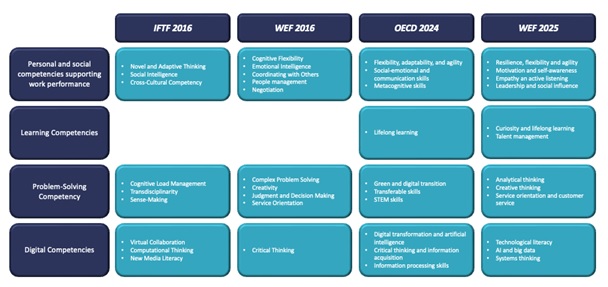
Sources: (IFTF, 2011 ; IFTF, 2016; WEF, 2016; Zahidi - Leopold, 2016; WEF, 2025; OECD, 2024)
International labor market reports consistently indicate that technical expertise and professional competencies alone are no longer sufficient for labor market success. Employers are increasingly prioritizing personal and social skills, including adaptability, leadership, collaboration, and a willingness to engage in lifelong learning. The findings suggest that as workplace expectations evolve, human-centric skills are becoming more valuable, as they enable employees to adapt swiftly to an ever-changing work environment.
Labor market reports strongly reinforce the rising importance of learning competencies and lifelong learning expectations. Employers recognize that successful employees not only rely on their existing knowledge but must also quickly adapt to new challenges, acquire new skills, and respond to technological and economic shifts. According to survey data, 72% of employers expect learning competencies to become even more critical in the future, while 50% already consider them a fundamental requirement today. The OECD and Cedefop emphasize that continuous learning extends beyond individual benefits, holding significant economic and societal value by enhancing employability, social participation, and labor market flexibility.
Problem-solving skills are among the most essential current and future labor market expectations. According to employers, 70% consider analytical thinking a key skill today, while creative thinking is also ranked among the most in-demand competencies. The OECD underscores the importance of transversal skills, which allow workers to apply their problem-solving abilities across different work environments and industries. The Cedefop report highlights that systems thinking, analytical skills, and critical thinking are essential for effectively addressing labor market challenges. Despite the advancements in artificial intelligence (AI), human problem-solving skills and creative thinking remain irreplaceable, as they complement automated processes and enable the resolution of complex tasks.
Digital competencies have also become a fundamental requirement across nearly all professions. 81% of employers identify AI and Big Data skills as highly important by 2030, while 73% predict that technological literacy will play an even greater role in shaping workforce expectations. Reports from the OECD and Cedefop emphasize that digital skills are not only crucial for high-skilled occupations but are increasingly required in lower-skilled roles as well, due to the widespread adoption of automation and digital systems across all sectors. Thus, developing digital competencies is not only essential for enhancing individual employability but also serves as a key driver of economic and social progress.
Autor, D. H., Mindell, D., Reynolds, E. (2023). The Work of the Future: Building Better Jobs in an Age of Intelligent Machines. The MIT Press.
Bridgstock, R. (2009). The Graduate Attributes We Have Overlooked: Enhancing Graduate Employability through Career Management Skills. Higher Education Research & Development, 28(1), 31 – 44.
Cedefop (2018). Forecasting skill demand and supply. http://www.cedefop.europa.eu/hu/events-and-projects/projects/forecasting-skill-demand-and-supply/data-visualisations (last download: 17/03/2025)
Cedefop (2023). "Skills in transition: The way to 2035" https://www.cedefop.europa.eu/files/4213_en.pdf (last download: 17/03/2025)
Cimatti, B. (2016). Definition, Development, and Assessment of Soft Skills and Their Role in Enhancing the Quality of Organizations and Enterprises. International Journal for Quality Research, 10(1), 97 –
Cserné Adermann, G. (2017). Az önirányított tanulás, Tudásmenedzsment, 1. évf. 1. sz. 4-10. http://epa.oszk.hu/02700/02750/00001/pdf/EPA02750_tudasmenedzsment_2000_01_004-010.pdf,
Czibik Á., Fazekas M., Németh N., Semjén A., Tóth I.J. (2013). Munkaerő-keresleti előrejelzés vállalati várakozások alapján. Két vállalati adatfelvétel tanulságai. Közgazdasági Szemle, 60. évf., 2. sz., 189-223.
Frey, C.B., Osborne, M.A. (2017). The Future of Employment: How Susceptible Are Jobs to Computerization? Technological Forecasting and Social Change. Vol.114. 254 – 280. https://www.sciencedirect.com/science/article/abs/pii/S0040162516302244 (last download: 05/03/2025)
Gallardo-Gallardo, E. (2018). The meaning of talent in the world of work. Global talent management, 33 – 58.
Habók, A. (2004). A tanulás tanulása az értelemgazdag tudás elsajátítása érdekében, Magyar Pedagógia, 104. évf. 4. sz., 443-470.
Harangi, L. (2010): A knowledge worker személyi kompetenciái, Kultúra és Közösség, IV. folyam, 1. évf. 4. sz., 23-30. http://epa.oszk.hu/02900/02936/00005/pdf/EPA02936_kultura_es_kozosseg_2010_04_023-030.pdf last download: 12/12/2024)
Hámori, B., Szabó, K. (2017). Tehetség, tanulás, munkapiaci esélyek. Előadás: Tehetség, tanulás, munkapiac, Vajdasági Magyar Közgazdasági Társaság, Szabadka,
https://www.researchgate.net/publication/259105142_HB-KSz_Tehetseg_tanulas_munkapiac (last download: 10/03/2025)
Horváth L, Baksa L., Csipke Á., Gutai L., Szilágyi D. (2022). 21. századi kompetenciák digitális technológiával támogatott fejlesztésének képessége: - pilot kutatás a TPACK21 skála adaptálásáról. Iskolakultúra, 32. évfolyam, 2022/6. Szám. 56-71. https://www.researchgate.net/publication/362735164_21_szazadi_kompetenciak_digitalis_technologiaval_tamogatott_fejlesztesenek_kepessege_-_pilot_kutatas_a_TPACK21_skala_adaptalasarol (last download: 19/03/2025)
IFTF (2011). Future Work Skills 2020 Report. https://legacy.iftf.org/uploads/media/SR-1382A_UPRI_future_work_skills_sm.pdf (last download: 17/03/2025)
IFTF (2016) Future Skills: Update + Literature Review. https://legacy.iftf.org/futureskills/ (last download: 17/03/2025)
Kiss, I., Répátczky, R. (2012). Új képességek és munkahelyek: kompetenciák a magasabb foglalkoztatásért. In: Csrenovitz, A., Szegedi, E. (ed). Munakerőpiaci orientált felsőoktatás. TEMPUS, Budapest
Kiss, P. (2010). Diplomás kompetenciaigény és munkával való elégedettség, In: Garai O., Horváth T., Kiss L., Szép L., Veroszta Zs. (szerk.). Diplomás Pályakövetés IV. Frissdiplomások 2010, Educatio Társadalmi Szolgáltató Nonprofit Kft., 111-123., https://www.felvi.hu/pub_bin/dload/DPR/dprfuzet4/DPRfuzet4_teljes.pdf, (last download: 03/03/2024)
Kopátsy, S. (2011). Új közgazdaságtan. A minőség társadalma. Akadémiai Kiadó, Budapest
Lukács A., Dorner H. (2021). Az élethosszig tartó tanulás, a munkahelyi képzések és a tudásmenedzsment összefüggései egy magyarországi kivállalatnál végzett esettanulmány alapján. Tudásmenedzsment 22. Évf. 1. szám 153-175. https://journals.lib.pte.hu/index.php/tm/article/view/5066 (last download: 18/03/2025)
Manyika, J., Sneader, K. (2018). AI, automation, and the future of work: Ten things to solve for. McKinsey Global Institute. https://www.mckinsey.com/featured-insights/future-of-work/ai-automation-and-the-future-of-work-ten-things-to-solve-for (last download: 10/03/2025)
Workforce (2016). A készségek forradalma. Digitalizáció, az ember és a képesség fontossága, Manpower Group Magyarország http://www.manpower.hu/images/SkillRevolution/MG_Skills_Revolution_HU_web.pdf, (last download: 17/03/2025)
McClelland (1973). Testing for competence rather than for "intelligence". American Psychologist. 28. https://www.therapiebreve.be/documents/mcclelland-1973.pdf (last download: 14/02/2025)
McKinsey & Company (2022). The future of work after COVID-19. https://www.mckinsey.com/featured-insights/future-of-work/the-future-of-work-after-covid-19 (last download: 17/03/2025)
McNamara, B.R. (2009). The Skill Gap: Will the Future Workplace Become an Abyss? Techniques: Connecting Education and Careers, Vol. 84, No. 5, 24 – 27, http://search.ebscohost.com/login.aspx?direct=true&db=a9h&AN=38906004&-lang=hu&site=ehost-live (last download: 17/03/2025)
Nagy, J. (2007). Kompetencia alapú kritériumorientált pedagógia. Mozaik Kiadó, Szeged
OECD (2021). Skills Outlook. https://www.oecd.org/en/publications/oecd-skills-outlook-2021_0ae365b4-en.html (last download: 17/03/2025)
OECD (2024). "Future Skills Summit 2024 - Issues for Discussion Paper"
https://one.oecd.org/document/SKC(2024)1/en/pdf (last download: 17/03/2025)
Randstad (2025). Workmonitor 2025. https://www.randstad.hu/hr-kutatasok/workmonitor/workmonitor-2025/ (last download: 17/03/2025)
PWC (2017). Digitalizáció és szakemberhiány. PwC Magyarországi Vezérigazgató Felmérés, PwC Magyarország, https://www.pwc.com/hu/hu/sajtoszoba/2017/magyarorszagi_vezerigazgato_felmeres_2017.html (last download: 17/03/2025)
Sági M. (2013). Pályakezdő diplomások munkába állási stratégiái, In Garai, O., Veroszta, Zs. (szerk.). Frissdiplomások 2011, Educatio Társadalmi Szolgáltató Nonprofit Kft. Felsőoktatási Osztály
Szabó, K. (2011). Állandósult túlkereslet a tehetségpiacon, Vezetéstudomány, 42. évf., 11.sz. 2-15.
Szelestey J. (2008). Kompetencia modell kidolgozásának elméleti háttere. http://www.erg.bme.hu/szakkepzes/4felev/SelesteyKompetencia.pdf, (last download: 13/03/2025)
Tongori, Á. (2012). Az IKT-műveltség fogalmi keretének változása. Iskolakultúra, 22 évf. 11. sz., 34-47., http://www.iskolakultura.hu/index.php/iskolakultura/article/view/21326 (last download: 17/03/2025)
Tóthné Téglás, T. (2016). Kompetencia vállalati, munkavállalói és felsőoktatás szemmel,. In: Csiszárik-Kocsir, Á. (szerk.). Vállalkozásfejlesztés a XXI. században IV., Óbudai Egyetem Keleti Károly Gazdasági Kar, Budapest, pp. 413-432.Tóthné Téglás, T., Hlédik, E. (2019). Munkáltatói kompetenciaelvárások vizsgálata piaci környezetben. Competitio, 18(1-2), 75-107. https://ojs.lib.unideb.hu/competitio/article/view/5519 (last download: 12/03/2025)
Tóth, I. J., Hajdu, M., Nyírő, Zs., Türei, G., Varga, A. (2015). Adatok a felsőoktatásról és a diplomások foglalkoztatásáról. Tények & összefüggések. MKIK GVI Kutatási Füzetek 2015/2, MKIK GVI http://gvi.hu/files/researches/402/gvi_kutatasi_fuzetek_2015_2_150330_.pdf (last download: 27/02/2025)
Ulrich, D., Smallwood, N. (2012). What is talent? Leader to Leader, Vol. 2012 No. 63, pp. 55 – 61.
Várhalmi, Z. (2012). Diplomás pályakezdők a versenyszektorban. MKIK GVI, Budapest
Velden, R., García-Aracil, A. (2010). Fiatal európai diplomások kompetenciái: a munkapiaci illeszkedés hiány és ennek megoldása, In: Garai, O., Horváth, T., Kiss, L., Szép, L., Veroszta, Zs. (szerk.). Diplomás Pályakövetés IV. Frissdiplomások. Educatio Társadalmi Szolgáltató Nonprofit Kft., 51-74., https://www.felvi.hu/pub_bin/dload/DPR/dprfuzet4/DPRfuzet4_teljes.pdf (last download: 14/02/2025)
World Economic Forum (2016). The Future of Jobs Report https://www.weforum.org/publications/the-future-of-jobs-2016/ (last download: 17/03/2025)
World Economic Forum (2020). The Future of Jobs Report https://www.weforum.org/publications/the-future-of-jobs-report-2020/ (last download: 17/03/2025)
World Economic Forum (2025). The Future of Jobs Report https://www.weforum.org/publications/the-future-of-jobs-report-2025/ (last download: 17/03/2025)
Wilkens, U. (2004). Von der individuellen zur kollektiven kompetenz? „Personalmanagement und Unternehmenskrisen” Herbstworkshop der Komission Konstanz, 24./25. September 2004. Personal. Paper (work in progress), http://www.apf.ruhr-uni-bochum.de/mam/aup/content/lit/wilkens_2004-von_der_individuellen_zur_kollektiven_kompetenz.pdf, (last download: 29/05/2019)
Zahidi, S., Leopold, T. (2016). What is the future of jobs? https://www.weforum.org/stories/2016/01/what-is-the-future-of-your-job/ (last download: 19/03/2025)
Zerényi, K. (2017) A képzettség és a foglalkoztatás közötti kongruenciával/inkongruenciával kapcsolatos megközelítések. Opus et Educatio, 4. évf. 1. sz., http://epa.oszk.hu/02700/02724/00012/pdf/EPA02724_opus_et_educatio_2017_01_105-114.pdf (last download: 10/11/2024).