
Máté Kálmán STIFT & Mónika OROSZNÉ PERGER
Engineering programmes are often characterized by high academic demands, concentrated assessment periods, and intensive project work. Students’ perceived manageability of workload, the clarity of expectations, the usefulness of feedback, and the availability of supportive peer communities can influence both academic progress and persistence (Astin, 1999; Tinto, 1975). Even within the same institutional environment, different faculties may develop distinct assessment rhythms, course organization practices, and support cultures, which can result in systematically different student experiences.
This study compares bachelor students’ perceptions at two BME faculties: GPK and VIK. The aim is not to rank faculties but to provide an interpretable, data-informed snapshot of where students report strengths and where development opportunities may exist. The paper focuses on five domains that students experience directly in everyday study life: workload and deadline pressure, teaching clarity and feedback, practical components, community integration and help-seeking, and overall satisfaction.
The relevance of the topic is practical as well as educational. In large engineering programmes, students’ everyday experiences often function as an early signal of structural strengths and weaknesses. If high workload is paired with predictable organization, accessible support, and meaningful practical learning, students may still evaluate their studies positively. By contrast, the same nominal workload may be perceived much more negatively when deadlines accumulate, feedback is limited, or students do not feel supported by their environment. Comparing two faculties within the same university therefore offers a useful opportunity to identify patterns that may inform programme development.
The theoretical background of the study draws on four closely connected areas of higher-education research: student engagement and persistence, workload perceptions, practical learning in engineering education, and the pedagogical role of feedback.
Student engagement and persistence. The literature on student involvement emphasizes that higher education is not merely a matter of curriculum delivery but also of how students invest time, energy, and attention into academic life (Astin, 1999). In this perspective, students are not passive recipients of knowledge; rather, their development depends on the intensity and quality of their participation in the educational environment. Closely related persistence models highlight that successful continuation in higher education depends not only on academic performance but also on social integration (Tinto, 1975). Students who feel connected to their peers and to the institutional environment are generally more likely to remain engaged, seek help when necessary, and interpret academic challenges as manageable rather than alienating. This is especially relevant in demanding engineering programmes, where strong peer networks may help students cope with difficult subjects and high assessment pressure.
Workload perceptions and timing. Student workload is a multidimensional construct. It is shaped not only by the amount of material or by the number of hours formally assigned to a course, but also by the timing, predictability, and transparency of tasks and deadlines (Kember, 2004). Two students may spend a similar number of hours on their studies yet report very different experiences of strain if one of them faces concentrated deadline peaks, unclear expectations, or sudden changes in assessment structure. Within the European higher-education framework, ECTS is intended to make workload more comparable and predictable by linking credits to estimated student effort (European Commission, 2015). In practice, however, perceived workload often depends on organizational and pedagogical factors that are not fully captured by formal credit values. This makes students’ lived experience an important complement to curricular planning.
Practical learning in engineering education. Engineering education research has repeatedly shown that practice-oriented learning forms, including laboratories, projects, and authentic tasks, can improve engagement and strengthen students’ sense of relevance and application (Prince, 2004; Freeman et al., 2014). Rather than functioning as mere supplements to theoretical teaching, such components often help students connect abstract concepts to professional contexts. In many engineering programmes, students report that these practical elements make learning more meaningful because they provide tangible experiences of problem solving, experimentation, and real-world application. High-impact educational practices, especially those that require active participation and sustained effort, are also associated with stronger developmental outcomes and more positive educational experiences (Kuh, 2008). In this sense, practical components may play a central role not only in skill formation but also in the way students evaluate the overall value of their programme.
Feedback as pedagogical support. Feedback is another key component of the student experience. Earlier pedagogical models already emphasized prompt feedback as one of the basic conditions of effective undergraduate education (Chickering and Gamson, 1987). More recent work has gone further by arguing that useful feedback is not simply information about past performance, but part of an ongoing learning dialogue in which students understand expectations, interpret comments, and use them to improve later work (Nicol, 2010). In large-scale higher education, this is often difficult to achieve consistently, yet the quality of feedback remains highly relevant for students’ sense of fairness, progress, and academic orientation. When students perceive feedback as timely and meaningful, it may also contribute to a stronger sense of workload manageability by reducing uncertainty and helping them prioritize effort more effectively.
Taken together, these strands of research suggest that workload, practical learning, feedback, and com-munity should not be interpreted as isolated factors. They are interconnected dimensions of the broader student experience, and their interaction may meaningfully shape how students evaluate their studies at different faculties.
The study is guided by the following research questions:
How do students at GPK and VIK differ in their perception of academic workload?
How strongly are practical components related to overall satisfaction at the two faculties?
What is the relationship between feedback, satisfaction, and perceived workload manageability?
How is community integration associated with overall satisfaction?
Does working alongside studies influence workload perception or modify the role of feedback?
Based on the literature reviewed above and on the practical context of engineering education, the fol-lowing hypotheses were formulated:
H1: Perceived workload pressure is high at both faculties, and the difference between GPK and VIK is at most moderate.
H2: The perceived usefulness of practical components is positively associated with overall satis-faction at both faculties.
H3: Feedback is positively associated with both overall satisfaction and workload manageability.
H4: Stronger community integration is associated with more favourable overall satisfaction.
H5: Working alongside studies increases perceived workload pressure and weakens the relation-ship between feedback and satisfaction.
We conducted an anonymous, voluntary online survey among current bachelor students and recent graduates from GPK and VIK. After removing incomplete cases where all Likert-type items were missing, the final dataset included N = 166 responses (GPK: n = 96, VIK: n = 70). Working alongside studies was reported by 41.6% of participants. In terms of gender composition, 77.1% identified as male and 22.9% as female.
Most items were 5-point Likert statements (1 = not at all characteristic / strongly disagree; 5 = fully characteristic / strongly agree). We computed composite scales as item averages to represent key domains:
(i) workload manageability (3 items), (ii) workload pressure (2 items), (iii) teaching clarity and instructor support (3 items), (iv) feedback (2 items), (v) practical components (4 items), and (vi) community integra-tion (3 items). Internal consistency of multi-item scales was assessed using Cronbach’s alpha (Cronbach, 1951).
Faculty differences in workload pressure were tested with Mann–Whitney U tests, and practical significance was summarized via effect sizes (Cohen’s d, Hedges’ g). Associations between scales were assessed using Spearman rank correlations. To explore whether working alongside studies moderates relationships, correlations were computed separately for working vs. non-working subgroups and compared using Fisher’s z-test.
The internal consistency of the workload manageability (α = 0.524) and workload pressure (α = 0.462) scales is lower than that of the other composite measures. This can partly be explained by the relatively small number of items included in these scales (three items in the former case and two items in the latter), and also by the fact that the items capture different aspects of how academic workload is experienced by students, such as weekly workload, the evenness of the semester, deadlines, and exam-period pressure. Accordingly, these scales are interpreted as indicators in the subsequent analyses. They are retained because of their conceptual coherence and their relevance to the hypotheses, but they are not treated as fully developed psychometric scales.
Figure 2. summarizes the mean values of the main scales by faculty. Students at both faculties report low-to-moderate workload manageability (below the midpoint), and high workload pressure. Teaching clarity and instructor support are rated moderately positively at both faculties. Practical components show consistently high perceived usefulness. Community integration is high overall, especially in the GPK subgroup.

Source: own editing
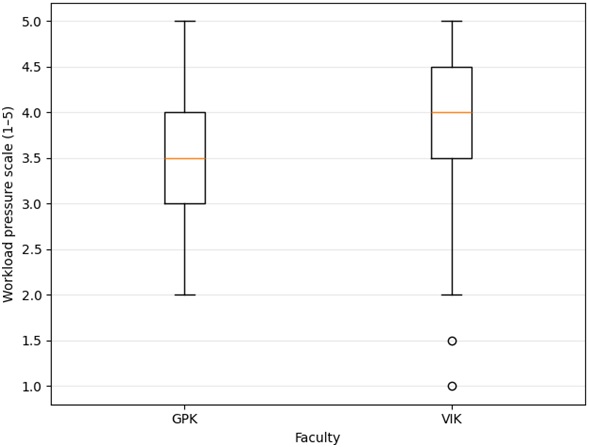
Workload pressure is high at both faculties and significantly higher at VIK (Mann–Whitney p = 0.0007), with a medium effect size (d = −0.473, g = −0.471). The distribution by faculty is shown in Figure 3. This suggests that students at VIK experience stronger exam-period pressure and task accumulation compared to GPK respondents.
Source: own editing
Perceived usefulness of practical components is positively associated with overall satisfaction at both faculties (GPK: Spearman r = 0.523, p < 0.001; VIK: r = 0.367, p = 0.0018). This pattern supports the view that labs and projects are not merely “extras” but meaningful contributors to the perceived value of the programme (Prince, 2004; Freeman et al., 2014; Kuh, 2008). See Figure 4.

Source: own editing
Feedback quality is positively related to overall satisfaction (r = 0.455, p < 0.001) and to workload manageability (r = 0.300, p = 0.0001). This aligns with the idea that usable feedback can help students navigate expectations and reduce uncertainty, which in turn supports a stronger sense of manageability (Nicol, 2010; Chickering and Gamson, 1987). The relationship is illustrated in Figure 5.

Source: own editing
Community integration is positively associated with satisfaction (r = 0.308, p = 0.0001). This finding is consistent with engagement and persistence frameworks emphasizing that social integration can support students under demanding academic conditions (Astin, 1999; Tinto, 1975). See Figure 6.

Source: own editing
Working status does not increase workload pressure in this sample (p = 0.8665, d = 0.031, g = 0.031). However, working moderates how strongly feedback relates to satisfaction: the feedback–satisfaction correlation is stronger among non-working students (r = 0.616, p < 0.001) than among working students (r = 0.164, p = 0.1776), and the difference is significant (Fisher z = 3.439, p = 0.0006). A plausible interpretation is that for working students, external time constraints and life context may dominate satisfaction judgements, reducing the relative impact of feedback quality.

The results suggest several practical implications.
Workload coordination. High workload pressure at both faculties, and especially at VIK, indicates that coordination of major deadlines and assessment peaks may meaningfully improve students’ sense of manageability (Kember, 2004; European Commission, 2015). Even small organizational changes can reduce unpredictability and clustering effects.
Strengthening practice-oriented elements. Practical components show consistently high perceived usefulness and a clear positive link with satisfaction. This supports continued investment in labs and projects, as well as clearer alignment between practical tasks and authentic engineering problems (Prince, 2004; Freeman et al., 2014; Kuh, 2008). Where feasible, linking practical tasks to explicit learning outcomes and professional contexts may strengthen the perceived value.
Feedback as a high-leverage mechanism. Feedback is related to both satisfaction and perceived manageability. In large courses, resource constraints often make detailed individual feedback difficult; how-ever, structured approaches such as rubrics, worked examples, short targeted comments, and aggregated group feedback can still provide usable guidance (Nicol, 2010; Chickering and Gamson, 1987). The weaker feedback–satisfaction link among working students suggests that flexibility and accessibility of feedback formats may be particularly important for students with external time constraints.
Community integration. Community integration is associated with higher satisfaction, consistent with engagement and persistence frameworks (Astin, 1999; Tinto, 1975). Supporting peer learning structures and visible help-seeking pathways may therefore contribute not only to well-being but also to persistence in demanding programmes.
The sample is convenience-based and not representative of all BME students. The design is cross-sectional, therefore causal interpretation is not warranted. Some scales are short and show lower internal consistency, especially workload-related measures, so they should be treated as concise indicators rather than as fully elaborated psychometric constructs. Future research could expand item pools, include additional faculties, and use longitudinal or mixed-method designs to better explain mechanisms behind perceived workload and satisfaction.
Bachelor students at both GPK and VIK report high workload pressure, with higher exam-period pres-sure at VIK. Practical components, feedback quality, and community integration are all associated with higher overall satisfaction. Working alongside studies does not increase workload pressure in this sample, but it moderates how strongly feedback relates to satisfaction. These findings point to actionable programme development directions: coordinated programme planning, strengthened feedback practices, and support for diverse student life contexts.
Astin, Alexander W. (1999). Student Involvement: A Developmental Theory for Higher Education. Journal of College Student Development, 40(5), 518–529.
Chickering, Arthur W., & Gamson, Zelda F. (1987). Seven Principles for Good Practice in Undergraduate Education. AAHE Bulletin, March, 3–7.
Cronbach, Lee J. (1951). Coefficient alpha and the internal structure of tests. Psychometrika, 16(3), 297–334.
European Commission (2015). ECTS Users’ Guide 2015. Retrieved from https://op.europa.eu/ en/publication-detail/-/publication/b1aa87a7-d8a4-11e5-8fea-01aa75ed71a1. Accessed 20 April 2026.
Freeman, Scott, Eddy, Sarah L., McDonough, Miles, Smith, Michelle K., Okoroafor, Nnedi, Jordt, Hannah, & Wenderoth, Mary Pat. (2014). Active learning increases student performance in science, engineering, and mathematics. Proceedings of the National Academy of Sciences, 111(23), 8410–8415.
Kember, David. (2004). Interpreting student workload and the factors which shape students’ perceptions of their workload. Studies in Higher Education, 29(2), 165–184.
Kuh, George D. (2008). High-Impact Educational Practices: What They Are, Who Has Access to Them, and Why They Matter. Washington, DC: Association of American Colleges & Universities.
Nicol, David. (2010). From monologue to dialogue: improving written feedback in mass higher education. Assessment & Evaluation in Higher Education, 35(5), 501–517.
Prince, Michael. (2004). Does Active Learning Work? A Review of the Research. Journal of Engineering Education, 93(3), 223–231.
Tinto, Vincent. (1975). Dropout from Higher Education: A Theoretical Synthesis of Recent Research. Review of Educational Research, 45(1), 89–125.